Guess What? There Isn’t One.
It actually depends on the picture, the approach the film will take in presentation, tone and production values, and the performances intended, all of which determine the audience and the budget the film can potentially support in the marketplace.
The Income Mix of Films in The U.S., 2021
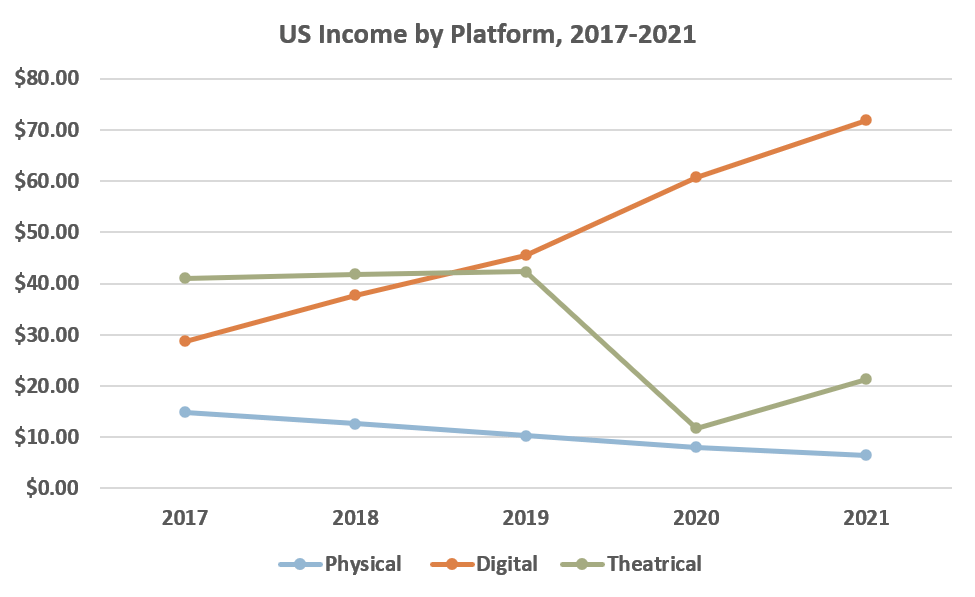
The chart above is just to show you that the world is continually changing.
The marketplace is in continual flux, and release models are mutable rather than fixed. Furthermore, at the top of this business, operators are often in the thrall of the latest fad. In one of the indie heydays, a domestic home video (VHS) contract could support the entire budget of an indie film, and they did. Then came indie theatrical release backed by DVDs and Blu-rays, and now digital delivery. Each has been able to support indie films, and the system still can, but the way the platform decisions are made can be unhinged from normal consumption value nowadays.
Because the system is in continual flux, every project requires its own purpose-built strategy. In the past year alone, I have finalized plans for
- A serial show being built for an ad-supported creator platform.
- A slate plan for a comic library with games, graphic novels, licensing and feature films in the mix, with audience targets, financial models and cash flow overall.
- A dual-strategy horror feature film with a marketing commitment built in and some of the best rock-solid incentives in the States.
- A slate of four target-market but each unique low-budget films with individual and slate cash flows.
- A family-friendly feature film being built as a stealth pilot.
Flexibility, and understanding the market for each individual project and its intended release pattern is imperative. A producer who does not do this game-planning will go out naked into the night. Building a financial model is not an exercise in prediction; it is an exercise in planning. Without a financial model not only can you not communicate to potential investment partners what the plan and potential is, you cannot follow a plan. Producers, directors plan the creation of the film and its shooting and assembly, and they should plan the financial and market life of their film.
Snapshot of a Portion of The FilmProfit(r) Financial Model for a Feature Film
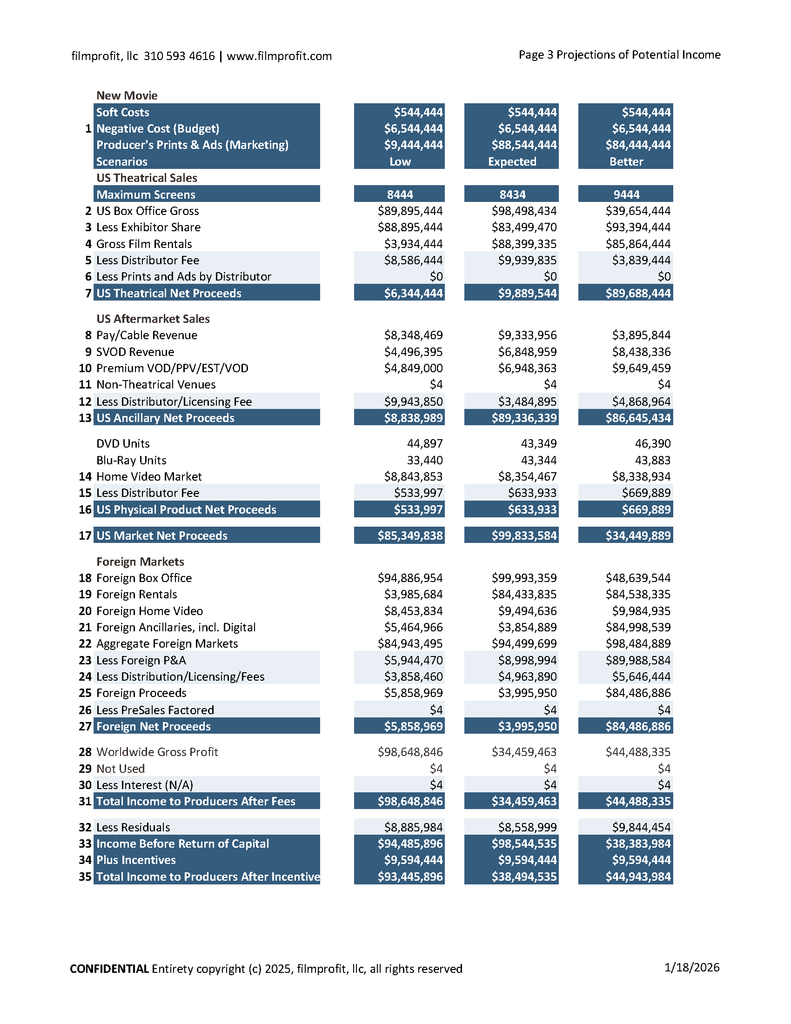
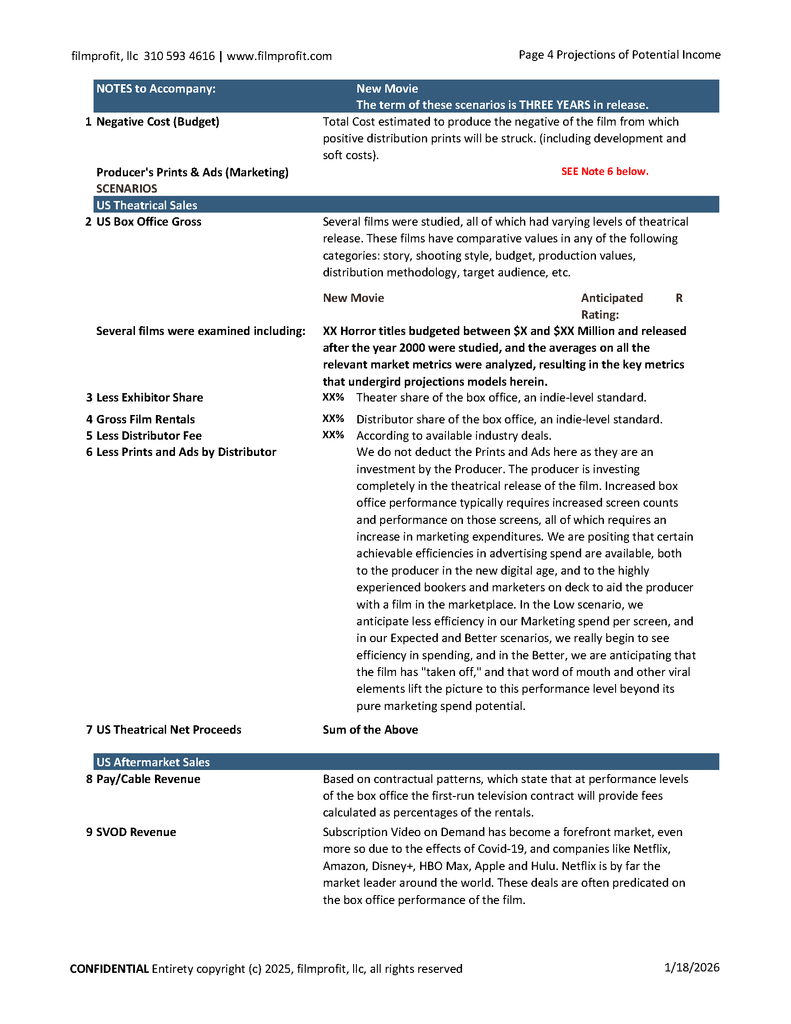
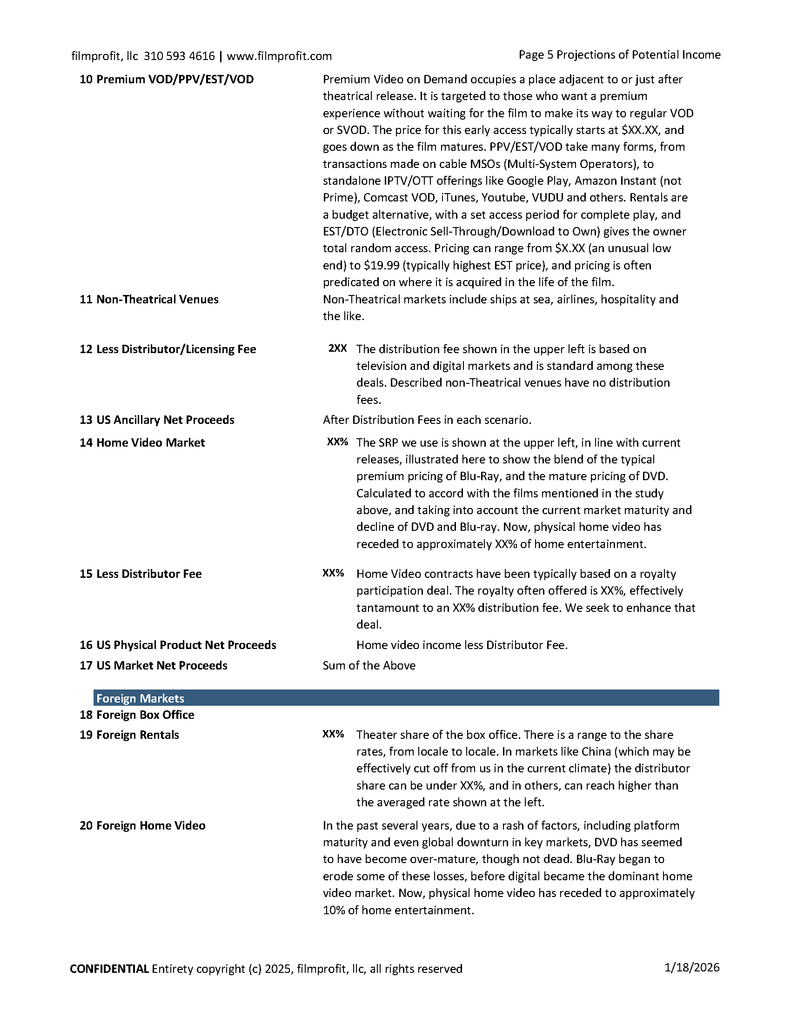
My clients, the writers, directors, producers, financiers have to be flexible enough to roll with what they find when they get to market, but that does not mean one should go into finance without a strong plan in hand, nor should they approach the release contract stage like a boxer who has not studied his or her opponent and formed a blueprint for the fight. Some absolutely want to focus on theatrical, and others are more agnostic about it.
This Is Not Yet Work any LLM Can Do
So, folks who think the approach to the financial model is just data that feeds numbers, and those numbers are all one is analyzing or presenting in a financial plan, need to understand that it is so much more than numbers. Financial modeling for a film is not accounting; it is a deep understanding of how the other parts of the business work. There is a high barrier to accomplishing this work on your own, even with using an AI companion, as the historical data, the institutional memory of this business, from the past up to today, is behind expensive and/or unbreachable firewalls. Accessing real value metrics for a film in release requires someone who has gathered, arrayed, and studied this highly sequestered and very expensive data over time—exactly as I have. Cripes! Is it possible to exit this constant AI discussion? I do not think so, as people all around us are diving in, from the top of the industry to the bottom.
What LLMs Do Know vs. What They Don’t Know in My Part of the Business
Data Type, Public Availability, LLM Knowledge
- Box Office, High (Box Office Mojo, The Numbers, Wikipedia), High. Public LLMs can recall total domestic vs. international grosses, opening weekend totals, and country-level summaries published on news sites.
- Market-by-Market, Very Low (Behind $$$$ paywalls), None. Public LLMs do not have access to private territory breakdowns, individual market platform data, or per-screen rental yields, or local distributor splits.
- Private Audits, Sequestered (Studio accounting, internal models, ledgers), None. Completely closed to LLMs and confidential.
NOTE: It’s important to know that box office (which might or might not be relevant to your film) does not tell you the profitability of your film. Two levels of revenue splits and expenses of many types are between you and that particular bucket of money. So, the readily available data is important, but is only a shadow of the money you will be targeting. SEE Income Mix chart above.
Over the last 20 years of FilmProfit, I have worked on hundreds of films which have raised somewhere in the vicinity of $200 million for production and release. I take this work seriously. When I take on a client’s project, I’m really trying to see the film or entertainment project the way the creator or team sees it. This is the first step. It is both informed, as I have worked on hundreds of projects and have studied and reported on thousands more, but it also must be fine-tuned to stay in touch with the creators of the film. So, the project will dictate the approach, while bending to and adapting to the team’s goals and the way the market is working. Every model is different.
The financial model is a reflection of every other decision made on the project, and that is why each is unique. So, the plan and strategy is then unique to the film, unique to the creators and unique to the market.
The Plan for Business
A Financial Model is part of the information matrix of the project, which itself lays out the plan for business. Other parts are the budget and production plan, any visualizations and story boards, cast, if any, and so are current market analysis and audience analysis. These can focus on a single report, like Projections, or be developed into a full business plan package, but certain key assumptions about each need to be understood together to have a reasonable financial strategy. If this weren’t true, then dreams of a computer program doing it for you could be real. I should know, I created the first financial modeling software, FilmProfit®, and had to write a book, The FilmProfit Guide to Film Distribution Deals, so you could even begin to use the software and understand what would happen to your film in release. I also created the first database of film performances that looked at each film holistically, all-markets in. This is all very hard work.
This can be a struggle for creative teams who just want to get to work making the film. But the reality of financing intervenes: the capital required is significant enough that investors demand a real plan to recoup it and turn a profit. These two desires and needs are in tension, but that tension causes an aware creative team to wrestle with this idea of market value. That is where I come in. We can analyze and craft a financial model and plan that enables a producer to communicate a holistic approach to the film that is real-world based and helps financial partners see the seriousness of the plan and gain confidence in the direction the team will take.
What is the purpose of this note to the world? One, is to help producers and creators know that there is a viable approach to prepping for finance, and one that is serious, thoughtful and holistic. The other is to quietly, but with determination, put a spear in the sand. This is where I stand, and though some might want bots or other computer programs capable of doing the really hard work of prepping a film for finance and for market, I know they are not there yet, and maybe never will be, just as writing a script is not a computer-aided remix of all the other movies made, and likely should never be.
Onward and Upward
Jeffrey Hardy