Now, Five Years Later
Almost exactly 5 years ago to the day, I posted an article (What in Holy Hell Are Indie Films Facing in 2021?) in which I focused on key challenges in the world of film distribution, through the lens of exhibition woes.
An important question to me at that time centered around utilization (financially) of the screen count footprint. Now, I have been talking for quite some time with everyone who would listen, about there being too many screens. Too many screens cause significant pressure on the theater owners, who can easily drift into starving for content, and into taking any big film that comes along, hoping it will resolve their stressed-out economic equation. This creates too much pressure in the equation for smaller to mid-sized films. Hence, the turning away from dramas, mid-sized films and even thoughtful character and art films.
The result is that screens are for the taking, distributors and exhibitors are not “right-sizing” the release, and studios generally keep producing big budget films and anxiously awaiting the weekend box office numbers with their hearts in their mouths.
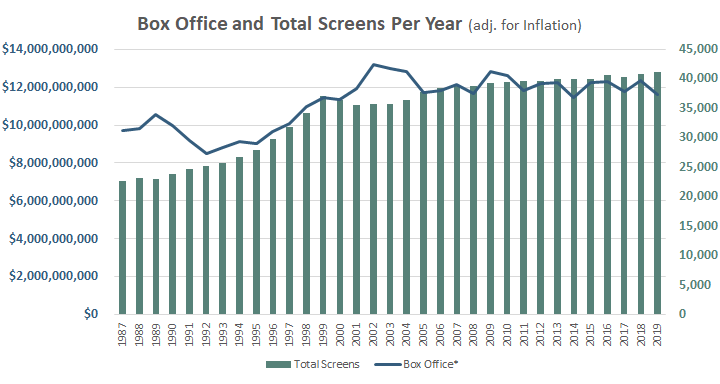
In the 2020 missive, this was the first chart I shared, illustrating over a wide range of time the impact of this overbuilding of screens matched against box office gained on those screens. Notice the narrowing of the profit gap.
Now, in the new 2025 chart below, it becomes extremely clear that screens are overbuilt even more so now. Remembering that movie theaters are primarily a real estate business, and are primarily supported by real estate loans, these businesses are under intense pressure to perform. This can result in catastrophic utilization of screen infrastructure allocated to achieving box office. Lordy, lordy, this means that the theater owners are at serious mercy of the studios, with little room to move other than to hope the producers/distributors create content that will keep them in business.
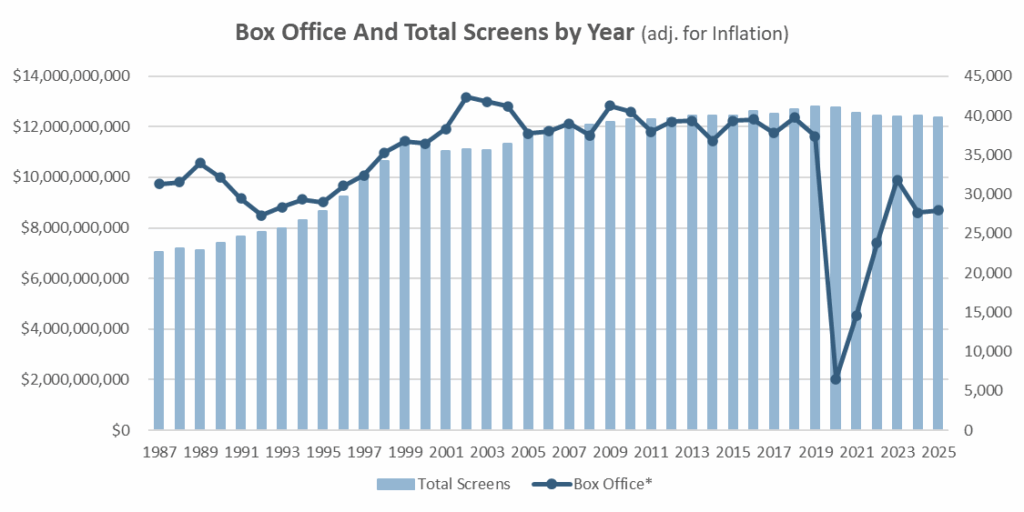
In 2025, some have begun to beg for more differentiated movies, but a lot of studio content is more like the same thing over and over. This isn’t about bashing the studios, but it is meant to illustrate the fact that the theaters are in a tight spot, and, as I have been saying for some time, theaters are over-built and have been for quite some time.
To make the point even clearer, I will post the average income per screen chart I made in 2020 that showed the state of things through 2019, and then how they are now, 5 years on.
November 2020 chart, showing results from 1987 through 2019. It is easy to see how the per-screen income has dropped steadily, even if not precipitously through 2019.
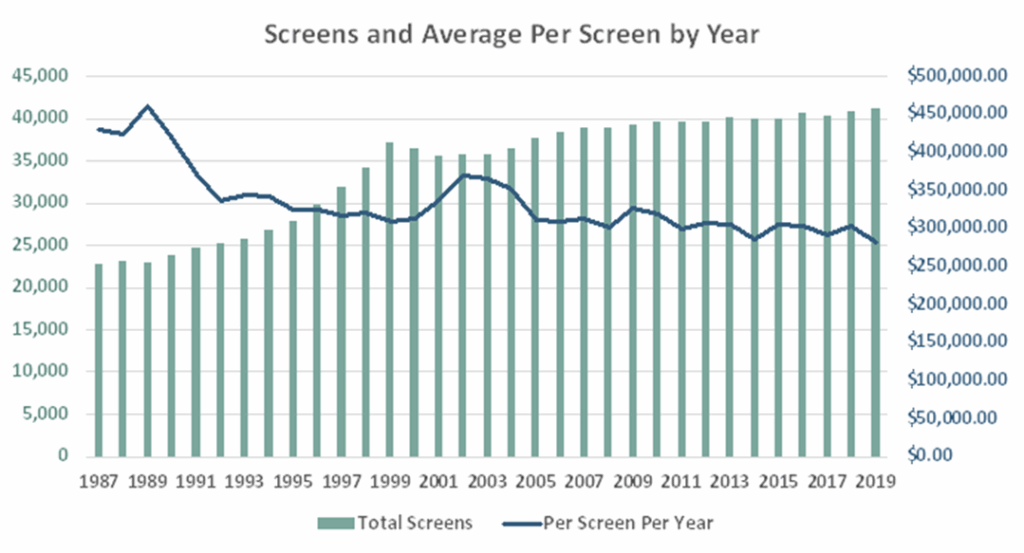
November 2020 chart, showing results from 1987 through 2019. It is easy to see how the per-screen income has dropped steadily, even if not precipitously through 2019. Notice the deep cuts into per screen income.
Then we cut to 2025
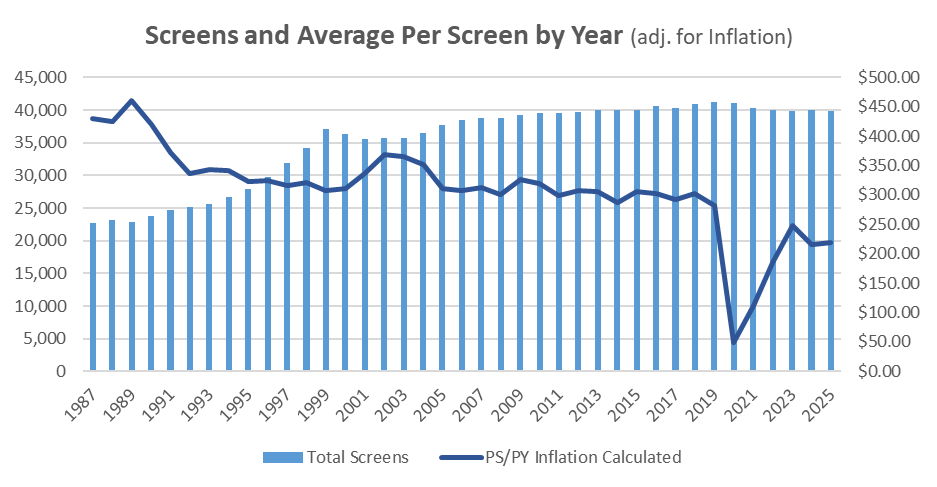
It was clearly a heyday in the late ’80’s, when screens were earning an average of $400,000+ per each screen.
But, then, after years of per-screen decline, Covid-19 and the lockdown hit and per-screen per year incomes to the theaters dropped precipitously. Yow! They have struggled to find their way back. With $50,000 per year earnings per screen in the depths of the lockdown, the business has been struggling to come back but hasn’t been able to regain seriously profitable footing.
Clearly, There Are Still Too Many Screens
I wish that meant that indie films could have a heyday and get in theaters with ease, so they could access their public (I call this access to shelf-space). But it has not meant that. Some independent filmmakers are going back to 1980’s indie roots and looking for any way to make personal connections with an audience. But movies are not inexpensive to make, and though theater owners make noises as if they want films to show, they clearly are caught in a vortex of expensive real estate and expensive buildings, and they don’t appear ready to relinquish any of it. Screens have clearly not retreated in ways that would heal these crazy mismatched numbers.
I am not going to worry here about how the big studios and big theater chains fix this beast of their own corporate making. But there are ways that these abundant screens could aid indies, but it only means that independent filmmakers, entrepreneurs, anyway, have to increase their entrepreneurship, take on more tasks (I know, hard already) in their already dense lives. Of course, a dream would be that each multiplex set aside one or more screening rooms and brand them as Indie venues. We have some indie houses, art houses, and indie chains like Alamo, and a few arthouses. But the big dream would be for the AMC and Fathom indie-embracing initiatives to bloom further and take excess capacity and use it for the financial betterment of both parties.
What Can Indies Do to Aid Themselves?
Be more focused on their audience, and who can be courted to be their audience. In my work, I am not only thinking about and reporting on the natural audience is, but also who the next and next nearest attendant audience can be for each film. The secondary and tertiary audiences are important to making sure you do not leave potential fans out of consideration. I am not building the marketing plans for films, but I am pointing the way and underscoring the necessity of “end-to-end” thinking for these film entrepreneurs.
Let me restate that –END to END– thinking, from the concept to the screen. Your idea is one end and your audience is the other end. Even if you get picked up by one of your target distribution partners, you really need to be prepared with information and intelligence, concrete information that can aid them in getting your film into the heads, hearts and hands of your soon-to-be fans.
Your audience is your savior, and your job is to get to know them by understanding them, then through knowing them, find them and communicate to them the existence of your film.
Yes, I did just create or underscore two more big jobs for the indie filmmaker who dreams of the A24/Neon/IFC/Roadside/Abramorama (among others) type of pickup of their film, to take these tasks off their hands. I think that should not be the plan, but even more independent thinking should be the plan. Even if your film were to be picked up by a really good distributor, you should know your audience, know where they are, know what they are activated by internally (I do not mean for manipulation purposes) and how they will be captured and moved and impacted by your film, because as an entrepreneur, you are embarking on a career long conversation with folks who will love, embrace, and then seek what you have to offer. Clarity at every step of this equation should be your goal and plan, and it starts with information and intelligence.
Too many screens, not enough compelling and differentiated films, big trouble for the chains. That is the backdrop to the world you are entering with your film. Like a bike messenger in crosstown traffic, your have to be quick and nimble and really get to know the route to your audience, and work hard to expand that audience at the edges.
There are folks like Ted Hope’s Hope For Film (Ted Hope | Substack), Dear Producer (Dear Producer | Substack), The Gotham (The Gotham), Film Independent (About – Film Independent) and the other film organizations that can also help you with this, but their checklists, their trench stories, their case studies and resources are all at the service of you doing this independent work on your own film so you can be prepared when you come face to face in presenting that film, to them, to anyone and to everyone else. This is your work.
Onward and Upward
Jeffrey Hardy
Subscribe and get these missives sent to you.
LIMITED TIME ONLY! In honor of the last Sundance in Park City, we are offering a 25% discount on Filmmaker's Financials Package and Producer's Financials Package. Use the discount code SUNDANCE2026 in your cart. This discount runs through February 14, 2026.
Quick questions, send them here.
To submit a project and get much more detailed information about our services, submit it here.

Leave a Reply